 |
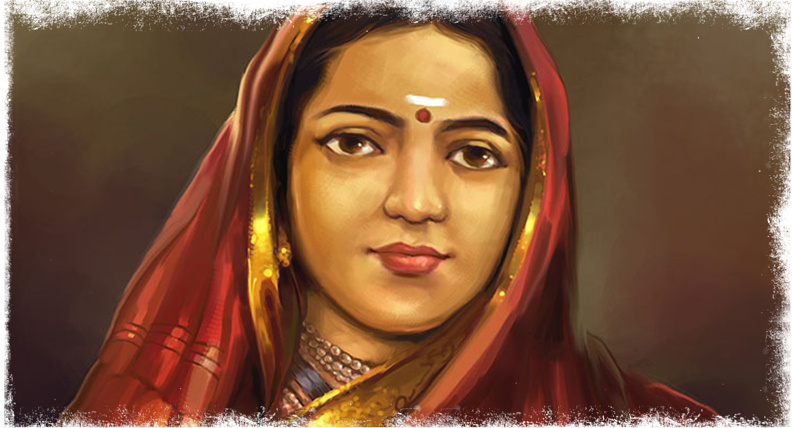
| Ahalyabai |
Ahalyabai (1735-95) was the daughter of one Manakoji Shinde of Chanute, in the district of Aurangabad. She was married to Khanduji, who was the son of Malhararao, a trusted assistant of the Peshwa. Khanduji, unfortunately, was a pleasure-seeking an indolent person. Ahalyabai, however, grew up to be an intelligent and dutiful woman. Her father-in-law coached her in administration and soon entrusted her with responsibilities of state affairs. She had two children: a son and a marriageable girl.
Khanduji died in 1754, and Ahalyabai then diverted all her energies to the affairs of the State. After the death of Malhararao, Malerao, her son, was nominally made the subahdar. But she was the de facto ruler.

Personally leading her army, she crushed the revolt of a Rajput clan and also quelled the revolt of the Bhil tribes of, Satpura.
Her son was a weak-minded boy, who eventually died after becoming insane. Her daughter also committed sat on her husband’s pyre. These were great blows to Ahalyabai, and she lived a life of austerity till she died on 13 August 1795.
Sir John Malcolm describes her as ‘one of the purest and most exemplary rulers that ever existed.’ The many good things that Ahalyabai did remain as monuments to her piety in the form of highways, wells, ghats, rest-houses, and temples. The most noteworthy among them is the road from Kolkata to Benaras and the temples of Somnath in Gujarat, of Vishnu at Gaya, and of Vishweshwara (Vishwanath) at Varanasi. She is still remembered throughout India for her benevolence and just rule.
Swami Vivekananda on Ahalyabai: So shall we bring to the need of India great fearless women — women worthy to continue the traditions of Sanghamitta, Lila, Ahalya Bai, and Mira Bai — women fit to be mothers of heroes, because they are pure and selfless, strong with the strength that comes of touching the feet of God.”
(Complete Works of Swami Vivekananda, Volume 5, page. 231)
‘Ahalyabai Rani had been perhaps the greatest woman who ever lived.’
(The Master As I Saw Him, Sister Nivedita, page.24
 SRI RAMAKRISHNA TODAY