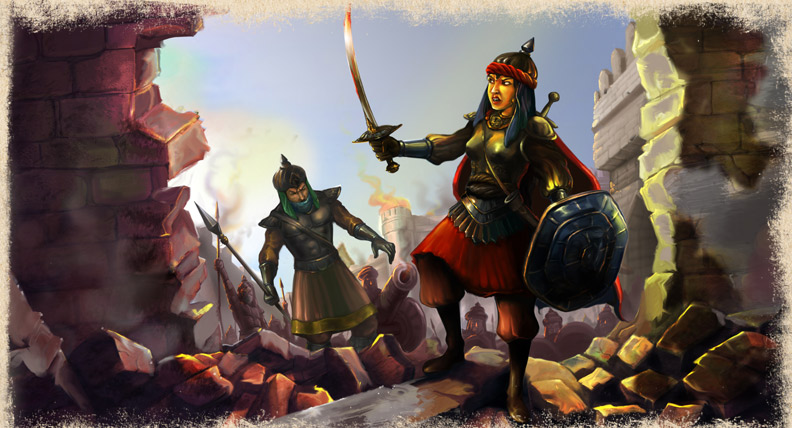
Chand Bibi (1547-99 A.D.) decidedly holds the foremost place among the Indian Muslim women
of the latter half of the sixteenth century. Daughter of Husain Nizam Shah of Ahmadnagar, she was born there in 1547 and was married to Ali Adil Shah of Bijapur. She proved a great blessing to her husband, who, recognizing her rich talents, consulted her on all administrative matters.
She used to ride with him on horseback to review the army parades and take an active part in his military campaigns, and when in 1580 her husband was treacherously murdered by a eunuch, and his nephew Ibrahim Adil Shah, a minor, succeeded him to the throne of Bijapur, she became the regent and the real ruler of his kingdom. However, the nobles, in order to grab power, conspired against her and even managed to confine her forcibly in a fortress in Satara. After being deposed in this manner, Chant Bibi was finally restored to her original position after a long struggle. But, when the Mughals attacked her kingdom, she was accused of treachery by a eunuch and was seized an executed in 1599. Lavish tributes have been paid to Chand Bibi by successive generations of India’s historians, which she deserves fully. In addition to her military genius and administrative skill, she was a good scholar of Arabic and Persian and could speak several Deccani languages fluently. Swami Vivekananda on Chand Bibi: The story of Chand Bibi, or Chand Sultana, is well known in India. She was the Queen of Golconda, where the diamond mines were. For months she defended herself. At last, a breach was made in the walls. When the imperial army tried to rush in there, she was in full armor, and she forced the troops to go back.—-(Complete Works of Swami Vivekananda, Volume 9, p. 201)
@page { margin: 2cm } p { margin-bottom: 0.25cm; direction: ltr; font-variant: normal; color: #181818; letter-spacing: normal; line-height: 120%; text-align: left; orphans: 2; widows: 2; text-decoration: none } p.western { font-family: “Merriweather”, “Georgia”, serif; font-size: 15pt; font-style: normal; font-weight: normal } p.cjk { font-size: 15pt } p.ctl { font-family: “inherit”; font-size: 15pt; font-style: normal; font-weight: normal } a:link { so-language: zxx }
 SRI RAMAKRISHNA TODAY