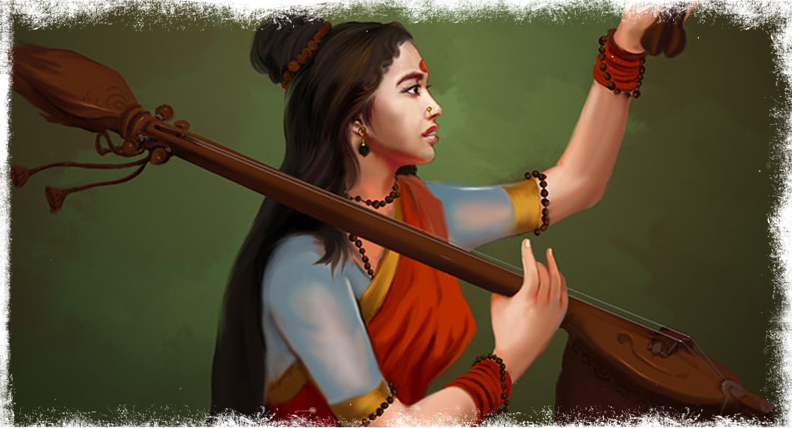
 Gargi was the daughter of sage Vachaknu and thus called Vachaknavi. Gargi appears to have been a more accomplished scholar, who questions Yajnavalkya at great length upon the origin of all existence, until the great sage, perturbed by her questionings, exclaims: ‘Ask not too much, Gargi so that thy head may not fall off thy body. Truly, concerning divinity, one must not ask too much. Thou dost ask too much, Gargi; ask not too much.’ Thus silenced, she was, however, not subdued. Again, in an assembly of sages, she seeks permission to ask two questions of the famous teacher, adding: ‘Should he answer those, none of you can ever beat him in describing Brahman.’ She then advances towards Yajnavalkya fearlessly with the words: ‘As a hero’s son from Benaras or from Videha strings the slackened bow and arises with two foe-piercing arrows in his hand, so I confront you with two questions. Answer me these.’ At the end of the highly philosophical dispute, she aclnowledges her defeat and very generously declares to the assembled sages: ‘You should consider yourselves fortunate if you can get away from him with a salutation; never shall any of you beat him in describing Brahman.
Swami Vivekananda about Gargi: ‘Do you remember how Yajnavalkya was questioned at the Court of King Janaka? His principal examiner was Vachaknavi, the maiden orator — brahmavadini, as the word of the day was. ‘Like two shining arrows in the hand of the skilled archer’, she says, ‘are my questions.’ Her sex is not even commented upon.’
(Complete Works of Swami Vivekananda, Volume 5, p. 320)
“…in the Vedic or Upanishad age Maitreyi, Gargi, and other ladies of revered memory have taken the places of Rishis through their skill in discussing about Brahman. In an assembly of a thousand Brahmanas who were all erudite in the Vedas, Gargi boldly challenged Yajnavalkya in a discussion about Brahman. Since such ideal women were entitled to spiritual knowledge, why shall not the women have the same privilege now?’
(Complete Works of Swami Vivekananda, Volume 7, pp. : 214-215)


 SRI RAMAKRISHNA TODAY