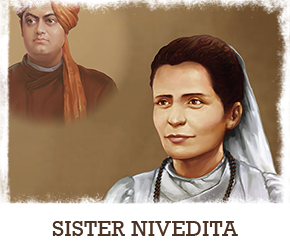
Nivedita was born Margaret Elizabeth Noble on 28th October 1867 in North Ireland. Inspired by the influence of her father and forefathers on the one hand and the ideals of her maternal grandfather on the other, she developed in her character truthfulness, religious zeal, patriotism and also an attraction for politics.
After successfully completing her formal education, Margaret became a teacher. She opened a school and started to teach students following her own methods due to which her name as a good teacher spread far and wide. She also started contributing articles in various papers and periodicals and participated in Church-sponsored service work.
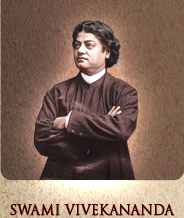
Margaret met Swami Vivekananda in November 1895 at London. She was charmed by his philosophical exposition and the personality and began attending all the classes and lectures, raised questions to resolve her doubts and constantly meditated on them. At last, she accepted him as her Guru. Swamiji was also convinced of Margaret’s truthfulness, determination and above all, her heart full of kindness.
Swamiji used to feel unbearable pain at the sorrows and sufferings of the common people of a subjugated India. He felt that in order to raise India it was necessary to improve the condition of the common mass and that of women. The only way to improve the condition of women was to give them an education. With the spread of education, they would become self-confident and would be able to solve their own problems. Swamiji thought Margaret would be eminently suitable for this task. He invited her for the task of spreading education among the women of India.
Margaret left behind her motherland, friends and relations, an established life and everything, and reached India on 28th January 1898 to join Swamiji’s task of nation-building. But first of all, it was necessary to know India. So day after day, patiently and with delicate care, Swamiji explained to her India’s history, philosophy, literature, the life of the common mass, social traditions, and also the lives of great personalities, both ancient and modern. She began to love India and developed an irresistible urge to accept the Indian life. Gradually India and she were merged together, as it were, to become one.
After a short while, Swamiji formally initiated Margaret in the vow of Brahmacharya and gave her the name ‘Nivedita’. He advised her to maintain strict continence and to dedicate her life for the good of others, like Buddha. Henceforth, the sole purpose of her life was to serve India. So she deemed her service to India to be the service to the entire mankind indeed.
As desired by Swamiji, she set up a Girls’ school at Kolkata and started the work of women’s education following the national ideal of India. She believed that in future Maitreyis and Gàrgis would emerge from amongst the students of this school. Nivedita used to teach the students history, geography, natural sciences and a little bit of English. She would also teach them sewing, drawing, and handicrafts. She also encouraged them to take up physical exercises. Above all, she helped them increase their innate sense of religion and introduced them to the Indian culture. She also made arrangements so that elderly married ladies and widows might have a little learning and know the art of sewing and other handicrafts. She gave special instructions to a few educated ladies in order to make them good teachers.
In 1902 after Swamiji’s passing away, Nivedita took upon herself the unfinished tasks of Swamiji. Since her arrival in India, Nivedita had realized in the core of her heart that foreign rule was responsible for the moral degradation and weakness of the Indians. From then on, Nivedita tried her utmost to enthuse entire India with the nationalist ideas. Nivedita’s conception of nationalism was to awaken a nationalistic consciousness in all the areas of national life—education, literature, science, history, arts and folk culture. Carrying afloat the banner of Swamiji’s ideals, Nivedita now set out on lecture tours throughout India. She appealed to the countrymen to forget all differences of caste, creed, and culture and come forward united to serve the motherland. Herself the image of selflessness, renunciation, and austerity, Nivedita’s sincere appeal touched the hearts of the people and enkindled patriotism in many a heart. She especially associated herself with the youths and student community.
During the Swadeshi Movement in 1905, Nivedita helped the leaders and the workers of the movement through all possible means. Nivedita maintained very close relations with Sri Aurobindo, the chief of the then revolutionary movement and other revolutionary leaders and workers. She was in touch with most of the front-ranking political leaders throughout India. Her foremost effort was that the Indians should unitedly fight against the foreign rule without creating divisions amongst themselves.
Nivedita accepted India as her own country serving the people of India in their days of sufferings and distress, caring even the least for her own life. In 1899, when the plague broke out in Calcutta she plunged into relief work with the band of sannyàsins of the Ramakrishna Mission according to Swamiji’s desire. Under her leadership, nursing of the ailing patients began, and side by side as a remedial measure to fight the disease, the cleaning operation of rubbish and refuse of the localities continued. Following her example, many local youths joined the relief work. When East Bengal was ravaged by a terrible flood, followed by a famine, she rushed there with her people for relief work. Wading through water and mud she reached the doorsteps of the common people and began to serve the distressed mass of people. Those distressed people also regarded Nivedita as their own and accepted her service without any reservation.
Nivedita encouraged and patronized the eminent Indian scientist Jagadish Chandra Bose, artists Abanindranath Tagore and Nandalal Bose, thinkers and historians Romesh Chandra Dutt and Jadunath Sarkar and other eminent personalities. She was an extraordinary orator and a powerful writer and wrote many books and articles.
Due to tremendous hardships and unfavorable climate, she began to fall ill repeatedly and finally passed away on 13 October 1911.
She always identified herself as ‘Nivedita of Ramakrishna-Vivekananda’. Never did anyone love India so much as did Nivedita. Never have we came across anyone who felt so proud about India’s religion and culture as she did or so committed to India’s national awakening as she was. By totally dedicating herself to the service of India, Nivedita proved true the name that was gifted to her by her Guru.
 SRI RAMAKRISHNA TODAY