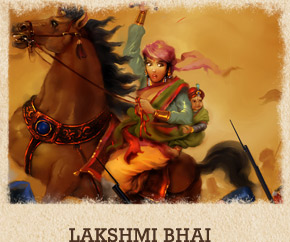
One of most valiant women in Indian history was Rani Lakshmi Bai. She was born on 18 November 1835 at Varanasi and was married early to Subahdar Gangadhar Rao, head of the small Maratha State of Jhansi formed by the Peshwas in 1743. The Subahdar died without issue in 1853, and his widow Lakshmi Bai was not permitted by the Governor-General-in-Council to adopt a successor. Jhansi was annexed to the British administration. The Rani, who was given a small pension, could not reconcile herself to ignominy and de¬pendence.

The rebellion began in India with the rise of the sepoys against their British officers at Meerut and Delhi on 10 May 1857, and gradually it spread to other parts of northern India.
On 5 June 1857 rebellion broke out at Jhansi, and the Rani stoutly defended the fort of Jhansi against Sir Hugh Rose. ‘It was the Rani of Jhansi’s evistom, states her own personal servant to Major S. C. McPherson, the political agent at Gwalior, “to lead her troops dressed in military uniform of the irregular cavalry—a crimson jacket, crimson trousers and a white turban, which made it impossible to tell her sex.'” Ultimately, finding her position exceedingly precarious, she made her adventurous escape from the fort through the cordon of British troops and bravely fought against the British in Bundelkhand from Kunch to Kalpi. At Kunch the Rani joined the indomitable Tantia Topi.
General Rose thus reviewed the change in the military situation in Central India: ‘The high descent of the Rani, her unbounded liberality to her troops and retainers and her fortitude, which no reverses could shake, rendered her an influential and dangerous adversary.’ When the British force attacked, the Rani was personally directing the batteries. Overpowered both by numbers and superior arms, her army was defeated. The Rani, though she fought valiantly, was also killed.
Swami Vivekananda on Lakshmi Bai: This mild Hindu race produces fighting women from time to time. Some of you may have heard of the woman [Lakshmi Bâi, Queen of Jhansi] who, during the Mutiny of 1857, fought against the English soldiers and held her own ground for two years–leading modern armies, managing batteries and always charging at the head of her army. This queen was a Brahmin girl.
A man whom I know lost three of his sons in that war. When he talks of them he is calm, but when he talks of this woman his voice becomes animated. He used to say that she was a goddess–she was not a human being. This old veteran thinks he never saw better generalship.
With such an education women will solve their own problems. They have all the time been trained in helplessness, servile dependence on others, and so they are good only to weep their eyes out at the slightest approach of a mishap or danger. Along with other things they should acquire the spirit of valour and heroism. In the present day, it has become necessary for them also to learn self – defence. See how grand was the Queen of Jhansi!
 SRI RAMAKRISHNA TODAY