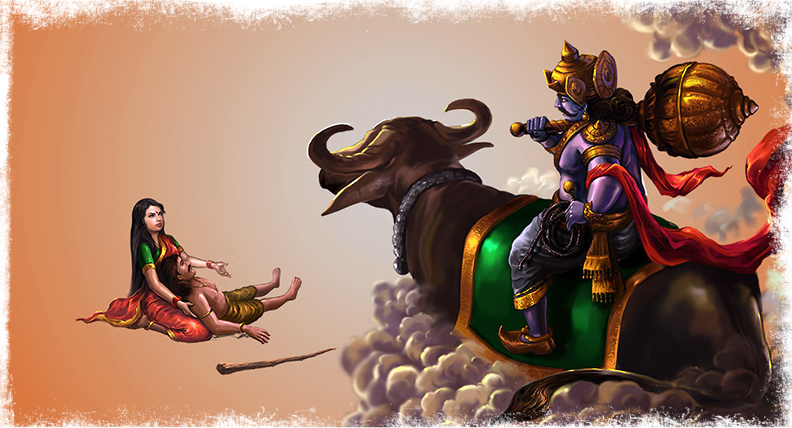
Savitri has been depicted as the ideal wife. Savitri’s memory is cherished not only in every Hindu home but also by those outside Hinduism. Orthodox Hindu wives still fast for three days in the month of jyaishtha (May-June) in her honour.
Savitri was born a princess, the beloved daughter of Ashwapati, king of the Madras. For many years the royal couple was not blessed with a child, for which they observed hard penances and performed rites. One day they were chanting the hymn to the goddess Savitri according to their custom when the deity appeared in the sacrificial fire and blessed them with the promise of a heroic daughter.

Brought up amidst luxury, one day, The grown Savitri, saw on one of her excursions to the forest, Satyavati (Satyavan) serving his old blind royal father and mother who had lost their kingdom. This sight made her give her heart to him and she couldn’t be dissuaded from taking it away even when Narada said that Satyavati had just a year to live. Satyavati married and the year in the forest passed in bliss. With only four days remaining for the year to be completed, she took up the vow of Triratra (three nights’ penance). Daily fasts, nightly vigils, and incessant prayers from her anguished heart burnt the last remnant of dross from her, and Savitri, pale and thin, shone like the flame of a lamp in a holy temple. When the fateful day dawned, Savitri accompanied Satyavati in the forest, who after a while felt faint and rested his head on her lap. Savitri then saw Yama, the terrible god of death, approaching with a noose. Savitri stood up. Yama drew Satyavati’s soul and loped the noose around it. Savitri then followed Yama and the conversation that took place between them is thrilling, ennobling, intelligent, and profound. She walked like Yama’s shadow even on repeatedly being dissuaded and told to return to the world of mortals. Yama became pleased with Savitri’s tenacity and granted her three boons except for Satyavati’s life. Even after the boons had been granted Savitri still followed Yama and spoke so sweetly that he granted her yet another boon. Savitri, who had by this time gained complete control over herself, said: ‘Grant me as the fourth boon that through Satyavat I may have one hundred sons, strong and wise, who will perpetuate our race.’ Yama absent-mindedly granted this. She then humbly asked that how could that be possible if Yama was to take away Satyavat? Yama, the divine dispenser of judgment, delighted to court defeat from one who was so pure, so loyal, and so fearless, said, ‘O worthy lady, here is your husband; freed by me.
Swami Vivekananda about Savitri: This is the story of Savitri, and every girl in India must aspire to be like Savitri, whose love could not be conquered by death, and who through this tremendous love snatched back from even Yama, the soul of her husband.
‘The fire on the Vedic altar, out of which arose Savitri, with her sacred calm and freedom, was ever the ideal background.’
 SRI RAMAKRISHNA TODAY