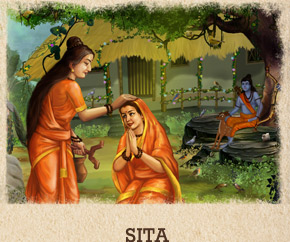

Sita had a succession of painful experiences. If the test of greatness is the capacity to remain true to one’s principles in spite of terrors and temptations, Sita’s greatness was undoubtedly more pronounced; for she had a greater power of endurance than any other character. Rama and Sita were equal in this respect, because every sorrow that affected the one affected the other as well, although they were situated in different environments. Hers was a special capacity, amidst the wailings and the complaints, to use her discrimination to cling to chastity and to act in a manner suited to the dignity of her parents, her husband, and other relatives.
Even to Rama, when occasions arose, she talked with firmness and quiet dignity. Her first serious trial came when Rama advised her to stay in the palace with an ‘undisturbed mind,’ engaged in religious rites and fasts and serving Dasharatha and Kaushalya. Partly offended, she said: ‘Do you think me mean-minded? It is not proper even to hear your words. I have been taught by my parents to follow my husband in all conditions of life, and I shall carry out now what I have been taught.
In all her talks with Ravana, either before her capture or during her captivity in Lanka, Sita never hesitated to warn him fully of his danger. Her arguments were few, but she put them clearly and fearlessly before him.
She was not destined to be happy in the company of Rama. Their lives, indeed, were not meant for their own enjoyment, but only to show by example how to lead a life of high ideals.
In her heroic struggle, she fought her battles in a manner appropriate to the wife of Rama. She had a twofold motto: She would, as she herself said to the Rakshasis, ever remain devoted to Rama. She would also sacrifice all her comforts, rights and privileges, including the company of Rama, and willingly undergo personal humili¬ations, if thereby Rama could be held up before the world as an ideal king, noted for his prowess, purity, truthfulness, and sense of justice.
Swami Vivekananda about Sita: ‘And what to speak of Sita? You may exhaust the literature of the world that is past, and I may assure you that you will have to exhaust the literature of the world of the future, before finding another Sita. Sita is unique; that character was depicted once and for all. There may have been several Ramas, perhaps, but never more than one Sita! She is the very type of the true Indian woman, for all the Indian ideals of a perfected woman, have grown out of that one life of Sita; and here she stands these thousands of years, commanding the worship of every man, woman, and child throughout the length and breadth of the land of Aryavarta. There she will always be, this glorious Sita, purer than purity itself, all patience, and all suffering. She who suffered that life of suffering without a murmur, she the ever – chaste and ever – pure wife, she the ideal of the people, the ideal of the gods, the great Sita, our national God she must always remain. And every one of us knows her too well to require much delineation. All our mythology may vanish, even our Vedas may depart, and our Sanskrit language may vanish forever, but so long as there will be five Hindus living here, even if only speaking the most vulgar patois, there will be the story of Sita present. Mark my words: Sita has gone into the very vitals of our race. She is there in the blood of every Hindu man and woman; we are all children of Sita. Any attempt to modernise our women, if it tries to take our women away from that ideal of Sita, is immediately a failure, as we see every day. The women of India must grow and develop in the footprints of Sita, and that is the only way.
 SRI RAMAKRISHNA TODAY