Swami Turiyananda
 |
Swami Turiyananda |
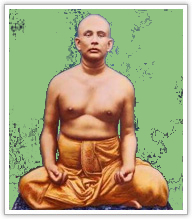
Swami Turiyananda was one of the sixteen direct sannyasin followers of Sri Ramakrishna. His pre-religious name was Harinath and individuals, for the most part, called him Hari. He was around eighteen years of age when he came to visit Sri Ramakrishna at Dakshineswar. At the point when Sri Ramakrishna saw him out of the blue, the Great Master promptly perceived the profound capability of Harinath and from that point on took the individual enthusiasm for his otherworldly improvement. Hari’s profound preparing under Sri Ramakrishna went on for a long time till the Master passed away. After the passing ceaselessly of Sri Ramakrishna, under the administration of Swami Vivekananda, Hari and a little gathering of young fellows who were likewise intently connected with the Master denied the world and progressed toward becoming priests. Hari moved toward becoming Swami Turiyananda. It is stated, of the considerable number of followers of Sri Ramakrishna, much the same as St. Francis of Assisi, even from his childhood Turiyananda treated his body with extraordinary apathy.
When he was just three years of age his mom kicked the bucket and when he was twelve years of age his dad passed away. He was taken care of by his senior sibling and his better half. His sister-in-law specifically treated him like her own child and took care of him with extraordinary love and love. For a mind-blowing duration, Turiyananda was extremely appreciative to her. At school, Hari was a decent understudy yet his genuine intrigue was otherworldliness and sports. Indeed, even from that youthful age, with the end goal to rehearse otherworldliness in the genuine feeling of the term, he was driving an actual existence of moderation in thought, word, and deed. With the end goal to keep his mind unadulterated, he diminished his rest and spent numerous hours in reflection. Pondering this time of his life Turiyananda later stated, “I don’t think I at any point dozed longer than three or four hours during the evening. The initial segment of the night I go in reflection. At that point, I have chosen that rest was a snag. So I used to sit up and watch the train of my contemplations. Thus my mind started to segregate ceaselessly between the interminable and the non-everlasting. At that point, I could rest no more. “I started to supplicate that I may rest. Yet, inside me was a current of bliss, as though somebody was stating, “Yet don’t you need to separate this way?”… “(1)
After he turned into a priest Turiyananda needed to invest his energy living in isolation, contemplating seriously, examining the sacred writings and visiting heavenly places. Like a genuine priest, he needed to rely upon God for sustenance and safe house. Remembering this he exited the religious community in Calcutta and going by foot he went to the Himalayas. In transit, he visited numerous sacred spots. In this manner, he spent numerous years as a meandering priest. In the event that he preferred a place and its very surroundings he would settle there for a couple of months and invest his energy in contemplation and investigation of the sacred writings… ‘Amid that period,’ he later reviewed, ‘my psyche dependably remained on an abnormal state. There was a consistent stream of God cognizance, whole like the stream of oil starting with one vessel then onto the next. I used to get up at daybreak, complete my ablutions, and sit for contemplation. In the wake of thinking for a few hours, I have begun perusing the sacred texts. At that point, the time had come to go out to gather sustenance, which was done rapidly. Next came some rest, after which I contemplated until night. No different musings were permitted to enter the psyche. Amid that period I focused on memory eight of the primary Upanishads, all aside from the two longer ones. At whatever point I found a Upanishadic section which especially spoke to me, I used to contemplate it. Goodness, what a delight this delivered! I can’t portray it… Whenever I focused on a stanza, I used to get new and crisp interpretations.'(2)
Turiyananda was a plain to the outrageous yet he was extremely thoughtful to other people, he was scholarly who had aced numerous Indian sacred writings in Sanskrit and the Bible yet his heart was brimming with delicate commitment. Despite the fact that he was raised in a customary Hindu culture yet he had an exceptionally present-day viewpoint. One winter when he was in New York, he and an understudy of his were strolling on a road secured with snow. They went over an expansive lake where they saw young men and young ladies skating on the ice. The children were calling and yelling and seeking after one another in the incredible fun. Seeing this Turiyananda commented to his understudy, “That is the reason you individuals are so solid and solid. Take a gander at the young ladies skating with the young men. What opportunity! Wish it were so in my nation. So honest and unadulterated! It is a sight for the divine beings to see… “(3)
At Swami Vivekananda’s ask for Turiyananda came to America to help him in his work. The main western priest of the Sri Ramakrishna arrange, Swami Atulananda says of Turiyananda when he saw him out of the blue, “The Indian environment still appeared to drift about him, as he was a long way from being Americanized. He spoken to India at the old understudies imagined her – the place that is known for straightforwardness, contemplation, and otherworldliness. Delicate, sprightly, reflective, minimal worried about the things of this world, Swami Turiyananda established a profound connection on the psyches of the individuals who considered Vedanta most important – not just as a theory to fulfill the judgment alone, yet in addition as a down to earth direction in their otherworldly life.”(4)
Stories from Turiyananda’s life
As a young man, when Turiyananda was at school he was continually perusing and rehearsing Vedanta. He continually attempted to recall that he was the Atman (soul) and not the body. He would wake up at a young hour early in the day around 3.30 A.M. what’s more, go to wash up in the Ganges waterway that streamed close to his home. One day when he was washing up in the waterway an occasion happened which fortified him in his creating otherworldly goals. Relating this episode Turiyananda later stated, “… One day I was to bathe as normal and I was in the stream. I saw a question drifting in the water. It was as yet dim, with the goal that I couldn’t recognize it. A few people on the shore, in any case, perceived the question as a crocodile. They yelled, “Turn out rapidly! That is a crocodile coming towards you!” Instinctively I raced to the shore. However, when I got out, I contemplated internally, “What’s going on with you? You are rehashing day and night, Soham! Soham! I am He! I am He! Also, now out of the blue you overlook your optimal (you are the spirit) and think you are the body! Disgrace on you!” I thought, Shiva, Shiva! That is valid.” And promptly I returned. The crocodile never tried to draw close to me. I washed of course. However, I have seen I was rushing to get past my shower rapidly. At that point, I said to myself: “No I will not hustle; I will wash up of course.” And so I did.'(5)
Once while in the Himalayan area called Tihiri-Garhwal, Turiyananda was living in a covered hovel that had a broken entryway. One night he heard the villagers cry, “Tiger! Tigert!” He instantly put a few blocks behind the way to secure himself. Simply then he recalled a section from the Taittiriya Upanishad that announces that even at the direction of Brahman the divine force of death does his obligation like a slave. His consciousness of the Atman stirred, and crushed the body thought. He kicked the heaps of block far from the passageway, and reflection. Luckily, the tiger did not indicate up. (6)
When Turiyananda was pondering in the northern piece of India he happened to enter a city called Mathura. In this city of Mathura, there happened to be an honorable disapproved of the rich trader who took upon himself the errand of sustaining meandering priests who went to his city. Turiyananda came to know about this vendor and being eager went to his home wanting to get some great sustenance to eat. He was given a decent dinner. After Turiyananda had his feast the trader moved toward him and asked him, “Will you please disclose to me how I can create dispassion?” At this Turiyananda grinned and stated, “You are making this inquiry. Do you figure I would have come to eat here on the off chance that I truly had dispassion?”(7)
 SRI RAMAKRISHNA TODAY