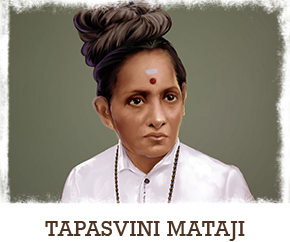
Mataji Gangabai or Tapasvini Mataji, as she was popularly called, was one of the pioneers in women’s education in India. Little is known about her life. She is believed to be born in 1835 in South India to a royal family belonging to Maharashtra. She is said to be a niece of Rani Lakshmibai of Jhansi though of the same age. From her childhood, she had prodigal memory and had deeply studied Sanskrit grammar, literature and scriptures. She was also trained in armed combat. After the demise of her father, she governed her estate well and started to build a strong state. However, soon after she gave up her estates and took to the ascetic life and came to be called as Tapasvini Mataji. During the freedom struggle of 1857, she plunged herself into the armed struggle herself leading a group of soldiers. After the movement subsided, Gangabai left for Nepal and resumed her spiritual practices. She is said to have influenced religious lives in Nepal and parts of Northern Bihar.
Having felt that education of women on Indian cultural and spiritual lines was the most important service needed for the nation, Mataji Gangabai came to Calcutta, then capital of British empire in India, and started imparting education to girls. She started her girls’ school called Mahakali Pathshala in Kolkata in April 1893 with only 30 students which gradually increased six-fold within 5 years. She had also started a press to publish books on moral and value-based teachings. She maintained her contact with many national leaders, like Bal Gangadhar Tilak and Sister Nivedita to inspire patriotism among the people. She was widely respected and admired. Tapasvini Mataji passed away on 20 April 1907 at Varanasi.
The fame of Mahakali Pathshala had spread far and wide. The students were taught about Indian ethos and cultural values free of cost. Having heard of the school, Swami Vivekananda came to visit it on 6 May 1897. Swamiji expressed his great appreciation of the measure of success Mataji had attained by her perseverance and application in the cause of diffusing education among women. In reply, she said with much humility, ‘In my service to my students, I look upon them as the Divine Mother; well, in starting the school I have neither fame nor any other object in view.’
After saluting Mataji, Swamiji went back to his carriage, which then proceeded towards Baghbazar, while the following conversation took place between Swamiji and the disciple.
Swamiji: How far is the birthplace of this venerable lady! She has renounced everything of her worldly life, and yet how diligent in the service of humanity! Had she not been a woman, could she ever have undertaken the teaching of women in the way she is doing? … The duty of teaching in the school ought to devolve in every respect on educated widows and Brahmacharinis. ….
Still, on this sacred soil of India, this land of Sita and Savitri, among women may be found such character, such spirit of service, such affection, compassion, contentment, and reverence, as I could not find anywhere else in the world!’
In the visitors’ book, Swami Vivekananda had made the following comment about the school: ‘I have great pleasure in witnessing to the good work inaugurated in our city by ‘Mataji’. The more appears to be in the right direction, and diseases support of all who desire to see their daughters educated on national lines!’
What Swamiji felt about the endeavours by the likes of Mataji has been summed up in his saying: ‘Studying the present needs of the age, it seems imperative to train some women up in the ideal of renunciation, so that they will take up the vow of lifelong virginity, fired with the strength of that virtue of chastity which is innate in their life-blood from hoary antiquity. Along with that, they should be taught sciences and other things which would be of benefit, not only to them but to others as well, and knowing this they would easily learn these things and feel pleasure in doing so. Our motherland requires for her well-being some of her children to become such pure-souled Brahmacharins and Brahmachari.’
 SRI RAMAKRISHNA TODAY