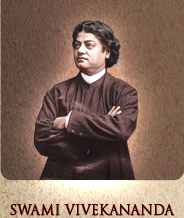
তিনি ছিলেন মূর্তিমান শক্তি; কর্মই ছিল মানুষের কাছে তাঁর বাণী।

swami vivekananda
swami vivekananda

তিনি ছিলেন মূর্তিমান শক্তি; কর্মই ছিল মানুষের কাছে তাঁর বাণী।

তিনি ছিলেন মূর্তিমান শক্তি; কর্মই ছিল মানুষের কাছে তাঁর বাণী। তাঁর প্রধান বৈশিষ্ট্য ছিল তাঁর রাজকীয়তা;আজন্ম সম্রাট তিনি। কি ভারতবর্ষে, কি আমেরিকায়, কোথাও এমন কেউ তাঁর পাশে আসেননি, তাঁর সেই রাজকীয়তার প্রতি যিনি সম্মান প্রদর্শন করেননি।
বিবেকানন্দকে দ্বিতীয় স্থানে কল্পনা করা অসম্ভব। যেখানেই গিয়েছেন, সেখানেই তিনি প্রথম স্থানে আসীন। তাঁকে দেখা মাত্রই প্রত্যেকে বুঝতে পারত, ইনি একজন নেতা, একজন ঈশ্বরপ্রেরিত পুরুষ;এমন এক চিহ্নিত ব্যক্তি যার মধ্যে সুস্পষ্ট প্রকাশিত অপরকে পরিচালিত করার শক্তি।

-নোবেল বিজয়ী ফরাসী সাহিত্যিক রোমা রোল

Vivekananda’s Unique Philosophy of Life Swami Gautamananda II विवेकानंद की यूनीक जीवन के दर्शन स्वामी Gautamananda

Everybody has the rationality to live by; a portion of these methods of insight are great, others terrible. This is so in light of the fact that not all individuals are effectively mindful of what is beneficial for them and for society. This numbness is because of inappropriate training or direction. Many don’t try to address yet stay content with air circumstances, anyway unrefined or narrow-minded. Once more, a portion of these methods of insight may not be functional in present day times and some might be too implausible and unattainable. Most of the individuals have sense delight as their objective, however, they may not let it be known! Some do everything to pick up a position, control, name, notoriety, etc on the grounds that they think these are the best things throughout everyday life. Each sort has a lot of contentions to legitimize their doings. As it were, they all have the reasoning of life. In any case, we are appeared by sages and holy people the way to express our interminable conceivable outcomes and achieve an express that is all around esteemed and regarded. The lives of Buddha, Mahavira, Christ, Sri Ramakrishna, and numerous other incredible people have exhibited this reality. 

New Path to Perfection 

Extraordinary holy people and prophets have encouraged that getting to be awesome or flawless is the most elevated objective of human life. All have pronounced that mankind is beneficiary to interminable life, limitless learning, love, and ecstasy. In spite of the fact that this is particularly valid as per the Indian ethos, it is likewise reverberated by other extraordinary identities, as Christ says: ‘Be ye along these lines immaculate, as your Father which is in paradise is perfect.’1 
This objective of flawlessness is achieved step by step in the wake of understanding the pointlessness of lower objectives, for example, sense satisfaction and financial power. We see that individuals once dependent on arousing joys become, by middle age, frustrated and disillusioned with those alleged joys. Comparable is the situation with the individuals who pursue riches and influence. In this way, the astute insight us against the quest for transient objectives: ‘Be otherworldly; understand that you are heavenly and you will accomplish the most noteworthy flawlessness by realizing that you are profoundly unfading, having interminable information and delight.’ They additionally proclaim that this objective is attainable and open to everybody. They strongly announce that there is no other method to blessedness than deliberately picking and attempting to realize our genuine nature. What’s more, this profound battle is portrayed in the Upanishads: ‘As troublesome as closed as a razor’s edge,’2 
what’s more, ‘this Atman isn’t accomplished by the weak.’3 
This battle is increasingly brave, exciting, and rousing than the victory of outer nature. The most recent extraordinary identity to demonstrate to us the way to blessedness is Swami Vivekananda. Guided by his Master Sri Ramakrishna, he crossed this troublesome way of control and delayed battles and demonstrated to us its legitimacy. Swamiji communicated this through a one of a kind reasoning of life that guaranteed us harmony and bliss in a fleeting life, just as enduring profound harmony and satisfaction. Swamiji needed his devout siblings to instruct the majority of India in mainstream and profound issues. He writes in a celebrated letter of 1894 from the US to his sibling supporters at the Alambazar cloister: ‘I am giving you another thought. On the off chance that you can work it out, at that point, I will realize you are men and will be of administration. … get together various poor, poverty-stricken people … show them stargazing, geology, and so forth., and lecture Sri Ramakrishna to them.’ 4
Hundreds of years of concealment and abuse had rendered individuals vulnerable. Presently, rather than relying upon frivolous rulers and lords or the British to accomplish something, Swamiji needed the recovery of India for the general population and by the general population. He previously needed to destroy destitution through specialized and other common training, which needed to oblige the ingraining of profound culture, the foundation of India since antiquated occasions. Swamiji makes reference to the accompanying exceptional zones 

of activity in a similar letter: 

(I) The requirement for getting to be sorted out, 

(ii) jolting society through one’s character, 

(iii) having a great many sannyasins and sannyasinis working magnanimously and eagerly, and 

(iv) the beginning focuses to spread Sri Ramakrishna’s life and message. He composed: ‘An immense profound tsunami is coming—he who is low will turned out to be honorable, and he who is oblivious will turn into the instructor of incredible researchers—through his elegance’ (6.294). 
And after that, in an astonishing presentation of perfect motivation, he closes: ‘Emerge! Wakeful!’ Great Lord! He is at our back! I can’t compose any more—Onward! I just disclose to you this, that whoever peruses this letter will assimilate my soul! Have confidence! Ahead! Incredible Lord! … I feel as though someone is moving my hand to compose along these lines. Forward! Extraordinary Lord! Everybody will be cleared away! Fare thee well, he is coming! Whoever will be prepared to serve him—actually no, not him but rather his kids—poor people and the oppressed, the evil and harassed, the individuals will’s identity prepared to serve these, in them, he will show himself! Through their tongue the Goddess of Learning Herself will talk and the Divine Mother—the Embodiment of all power, will enthrone Herself in their souls! (6.295). 
Swami Vivekananda talks about showing history, topography, space science, and present-day sociologies so as to stir the Indian masses. He realized that singular bliss lays on the joy of others, and arousing individuals was the initial move towards an inside and out national advancement. His ‘new thought’ was a long way in front of even a lot later socialist developments in certain pieces of the world, which fizzled in light of the fact that they couldn’t comprehend the otherworldly element of the individual. His original thought was at first not generally welcomed by his own sibling devotees! Be that as it may, Swami Vivekananda, a conceived pioneer, was diagramming another way for mankind while profoundly broadening the old perfect of ‘Bahujan hitaya bahujana sukhaya; for the benefit of the many, for the joy of the many’. In a piercing letter kept in touch with the Maharaja of Mysore, he says: ‘My respectable Prince, this life is short, the vanities of the world are transient, however only they live who live for other people, the rest are more dead than alive’ (4.363). 
Otherworldly life, in the hands of Swamiji, was made proactive and reasonable through the administration of the Atman taking all things together. Swamiji needed a sound trade of thoughts between the East and the West. Western innovation must be utilized to inspire the poor masses, and qualities appreciated by the orient for a huge number of years educated toward the West in return. He talked about mass instruction going from way to entryway utilizing the enchantment light, maps, diagrams, etc. Today essential training in India, after so long, is a privilege and a reality. Lamentably, the hole between the rich and the poor has not been connected, however, a major begin has been made for the poor to ascend and quit being misused. We likewise need to adequately utilize all the innovative improvements, for example, electronic media, PCs, and the Internet to carry the majority into the standard. Swamiji was constantly positive and current in his methodology, and his supporters will likewise be so. Separation training can be utilized to ‘come to the unreached’, even in remote timberland and slope clans and networks. 

Otherworldly Awakening, the Need of the Hour 

Swamiji needed to kill neediness, yet he needed, considerably more, the destruction, through otherworldly Awakening, of self-centeredness, disunity, desire, and defilement, which can occur? These hindrances of human advancement could be killed by engendering the character, lessons, and religion of Sri Ramakrishna, who lectured the godliness of mankind, of the universe, and the agreement all things considered. ‘This’, Swamiji stated, ‘is the main otherworldly practice, the main love, this verily is the methods, and this the objective’ (6.294). 
Swamiji’s require a national awareness was extraordinary. In his exposition ‘Aryans and Tamilians’, he demonstrated the basic solidarity of the country and invalidated the Aryan attack hypothesis. He said that the entire of India was of one race just, called Aryan in the North and Dravidian in the South, both starting from the race that occupied India from ancient occasions. Next, he needed to stir the lethargic otherworldly awareness of the country through the repropagation of moksha, profound opportunity, and the transient perfect of scholarly and monetary advancement dependent on dharma. He needed everybody to make progress toward one’s self-acknowledgment through administration, renunciation, and penance. This way would prompt focus, contemplation, and acknowledgment, which the rishis of old accomplished through long stretches of tapasya, starknesses. Accordingly, Swamiji admonished: ‘They had many Rishis in antiquated India. We will have millions—we will have, and the sooner all of you puts stock in this, the better for India and the better for the world’ (3.284). 
In the subjugated, sleeping India of the 1890s would it say it was ever feasible for 300 million individuals to ascend to progressed toward becoming rishis? A similar inquiry can be posed of present India, with its 1.2 billion individuals. Swamiji decidedly says: ‘Wherever his [SriRamakrishna’s] name will achieve, the veriest worm will accomplish heavenly nature’ (6.294). 
This rishi-hood, that is, the perfect of all-round advancement of the identity, can be accomplished by keeping before us the fourfold purusharthas, objectives of human life: dharma; Martha, riches; kama; and moksha. The mission for the purusharthas can change the forces of the body and the brain into sound channels of articulation, helping accordingly to lessen bends emerging from childishness. Give us a chance to take up the four objectives of life as talked about by Swamiji.

Dharma, Artha, and the Kama 


Artha and kama are interconnected. Riches empowers one to appreciate joys through the faculties; joys, thusly, make the requirement for more riches. In this manner, a circle is made of riches prompting pleasure, and hunger for greater happiness prompting more riches. Yet, the hunger for satisfaction must be controlled for the accompanying two reasons: 

(I) The faculties have their confinements and along these lines overstretching them gets sicknesses and unexpected passing, and 

//pagead2.googlesyndication.com/pagead/js/adsbygoogle.js

(adsbygoogle = window.adsbygoogle || []).push({});

(ii) sense happiness constantly prompts possessiveness and self-centeredness influencing others’ opportunity. In this way, these conflicts and battles would not be helpful for joy. Who is to control this hunger for delights? The individual needs to do it through his or her own inner voice. There is no other way. Dharma should frame the reason for the obtaining of riches and delight. The cutting edge contention that there is no requirement for dharma or qualities in obtaining riches or pleasure appears to be completely shallow. Moreover, one before long learns the unforgiving truth that riches and happiness devastate oneself. The Bhagavadgita says that God embodies, over and over, to direct humankind along the lines of new dharma to suit another age. Such a symbol has come back again as Sri Ramakrishna. In a wonderful tribute to his Master, Swamiji announces: ‘Sri Ramakrishna, the satisfaction of the Indian sages, the sage for the time, one whose educating is a little while ago, in right now, generally advantageous. What’s more, mark the perfect power working behind the man. The child of a poor minister, conceived in an off the beaten path town, obscure and unthought of, today is revered truly by thousands in Europe and America, and tomorrow will be venerated by thousands more. Who knows the plans of the Lord!’ (3.268). 
We construe from the over that Swamiji’s thoughts with respect to the four purusharthas are none other than Sri Ramakrishna’s, which are most significant to the present age. It is, figuratively speaking, Sri Ramakrishna who talks through Swamiji, who says: ‘This human body is the best body known to mankind and the person the best being. … Even the Devas (divine beings) should descend again and achieve flawlessness through a human body'(1.142). 
The principal obligation of an individual is to understand one’s own magnificent heavenly nature. To accomplish this one ought to have confidence in oneself and in God. ‘The best religion is to be consistent with your own inclination. Have confidence in yourselves! On the off chance that you don’t exist, in what manner would god be able to exist, or any other person?’ (1.483). 
We should take note of that by the above glorification of the individual, Swamiji repeats that one’s station isn’t an obstruction for the most elevated mainstream or religious accomplishment. This is additionally the message of the Mahabharata, which says that neither birth, holy observances, lineage, or studies make an individual dvija, twice-conceived, yet character and lead alone does. Swamiji depicts how we can accomplish joy in this world: ‘Man thinks absurdly that he can fulfill himself, and following quite a while of battle discovers finally that genuine satisfaction comprises in slaughtering childishness’ (1.84). 
This joy can be at the physical, mental, good, or profound dimension, the toughness, and power expanding at each succeeding dimension. This satisfaction is legitimately corresponding to opportunity, and otherworldly delight is the most elevated since it gives the opportunity. 


Sustenance, Education, and Happiness 


//pagead2.googlesyndication.com/pagead/js/adsbygoogle.js

(adsbygoogle = window.adsbygoogle || []).push({});

Sustenance is a significant part of human joy. Swamiji exhorts us: ‘Certain guidelines as to sustenance are vital; we should utilize that nourishment which presents to us the most perfect personality’ (1.136). 
Be that as it may, obsession with respect to the decision of sustenance—veggie lover, non-veggie lover, veggie lover, or ‘vegan’— ought to be shunned. The sustenance that one is habituated to from one’s adolescence ought to be useful for that hopeful, however after an expansion of otherworldliness that also changes as needs be. Swamiji exhorts that meat eating can’t be altogether censured, even with the glaring proof that among the meat-eating kshatriyas are the creators of the Upanishads, just as symbols, for example, Rama, Krishna, and Buddha. Most of the devotees of every single real religion are additionally meat eaters. ‘Is God an apprehensive trick like you that the progression of His stream of benevolence would be dammed up by a bit of meat? In the event that such be He, His esteem isn’t a pie!’ (4.359).
However, Swamiji likewise pronounces that for a sannyasin, veggie lover sustenance would be better: ‘To eat meat is clearly savage and vegetable nourishment is surely cleaner—who can deny that? For him without a doubt is an exacting veggie lover diet whose one end is to lead exclusively a profound life’ (5.485). 
Training assumes a crucial job in satisfying an individual. Subsequently, Swamiji regularly called great instruction ‘man-production’, since it advanced an individual’s overall development: physical, scholarly, passionate, good, and profound. He characterized training as ‘the sign of flawlessness as of now in man’ (4.358). 
An informed individual ought to build up a solid resolve, which originates from the intensity of learning and feelings meeting up. This determination should control one along the correct way, to work proficiently, and accomplish the greatest with an insignificant consumption of vitality. Training should make individuals well-meaning, kind, charitable, and bold to battle for worthy motivations. As the entire of creation has issued out of the Supreme Soul, and the jiva is a piece of this preeminent Soul, an individual has the learning of everything ‘covered up inside one’s psyche’. Training is ‘revealing’ this torpid learning. This idea of training, as a back to front indication, gives everybody the chance and want to achieve extremely high, if one battle sufficiently hard. Legitimate training builds up an illuminated society in which, essentially, the greater part must be householders. Swamiji talks about how people can live cheerfully in their families: ‘The householder is the premise, the prop, of the entire society. He is the chief worker. Poor people, the frail, the youngsters and the ladies who don’t work—all live upon the householder’ (1.45). 
He proceeds: ‘The standard for a householder about the use of his pay is, one-fourth of the pay for his family, one-fourth for philanthropy, one fourth to be spared, one-fourth for self ‘ (6.114). 
A decent householder is relied upon to procure well and spend well. Swamiji considers this a ‘love’, proportionate to an ascetic’s profound practices, in light of the fact that behind both is simply a similar temperance surrender and generosity, provoked by the sentiment of dedication to God and to all that is his. Once more, the householder must be an individual of character. Swamiji says: ‘Celibacy is the main ideas in man or lady’ (1.67). 
The spouse should view every other lady as his mom, girl, or sister. The spouse has the more noteworthy duty of bringing back a wayward husband through the intensity of her adoration and virtuousness. A householder ought to carry on towards his or her relatives as a ‘nurture’ in a rich man’s home, trusting that every one of them is not one’s own but rather truly God’s! A householder, to his foes, must be a saint; he should oppose them and never talk of non-opposition. To his companions and relatives, he ought to be delicate. He ought to shun unfortunate propensities like betting, the organization of the fiendish, etc and battle to win a decent name. The householder’s life is preparing in benevolence, administration, penance, and renunciation, to turn into ‘a sannyasin without a clothing’ and rapidly achieve moksha. While alluding to a householder’s life, we need to take a gander at what standards Swamiji set for ladies. ‘To all ladies, each man spares her significant other ought to be as her child’ (5.412). 
Ladies are commonly religious; on the off chance that they can save this quality and at the same time build up their insight through training, they remain a gift to any general public. Ladies ought not only to be an adornment of the house or look lovely however create profound quality, otherworldliness, and immaculateness at home and at work. Swamiji dependably lauded the job of ladies as pioneers and as moms. The incredible sage Manu talked about the mother as equivalent to a thousand educators. Swamiji had confidence in the ladies’ job in showing religion and spiritualizing the world. He kept in touch with a woman: ‘If strong and capable ladies such as yourself, versed in Vedanta, go to England and lecture, I am certain that consistently many people will end up favored by receiving the religion of the place where there is Bharata. … If an Indian lady, in Indian dress lectures there the religion which tumbled from the lips of the Rishis of India—I see a prophetic vision—there will rise an incredible wave which will immerse the entire of Western world’ (4.485– 6). 
Significance of Dharma and Moksha Till now we have seen a portion of Swamiji’s remarkable thoughts with respect to abhyudaya, common success. Presently given us a chance to direct our concentration toward his interesting message for achieving nihshreyasa, most noteworthy otherworldliness. Swamiji’s essential message was to stir individuals to their own otherworldly glory.’ No books, no sacred texts, no science can ever envision the greatness of the Self that shows up as the man, the most sublime God that at any point was, the main God that existed, exists or ever will exist’ (2.250). 
To show this Divinity Swamiji exhorts: ‘Our first obligation isn’t to despise ourselves in light of the fact that to propel we should have confidence in ourselves first and after that in God’ (1.38). 
Obligation turns out to be simple on the off chance that it is in accordance with our aptitudes. We should choose the work we like commonly, to, therefore, serve ourselves and society better. This moves toward becoming svadharma, one’s dharma. This can give us an extraordinary grouping of the psyche, the virtue of heart, lastly profound illumination. Swamiji instructs us that each obligation is blessed and commitment to obligation is the most elevated type of love. We are altogether brought into the world with different preferences and henceforth certain obligations suit our temperament though others don’t. Let us not protest about others having distinctive attempts to do. That would excite jealousy and murder all thoughtfulness in our heart for other people. In the event that we recollect this, we will love our works and our obligations will end up better. This is the manner by which guardians love obligations towards their kids, spouses obligations to their wives, etc. Swamiji then instructs that genuine quality ought to be both physical and mental.
Mental quality lies in the confidence of our own Divinity: 

//pagead2.googlesyndication.com/pagead/js/adsbygoogle.js

(adsbygoogle = window.adsbygoogle || []).push({});

‘Men are instructed from youth that they are frail and miscreants. Instruct them that they are for the most part magnificent offspring of everlasting status, even the individuals who are the weakest in sign. … Say to your very own personalities, “I am He, I am He”. … That is valid; the vast quality of the world is yours’ (2.87). 
This quality is inside; it is better, it is courage. That is the thing that our Upanishads educate. Swamiji says: ‘The main religion that should be educated is the religion of courage’s (3.160). 
Carrying out one’s responsibilities to others by observing God in them is karma yoga. This makes one completely free from all narrow-mindedness. Swamiji con considered selflessness as the substance of all integrity. Genuine morals depend on the unity of everything being equal. Karma yoga is the way through which by serving others with this thought of unity, one accomplishes otherworldly edification by creating total benevolence. The direct opposite of ‘unity’ is ‘benefit’. The pleasure in any favorable position over another is called benefit. The point of ethical quality is its obliteration. On the off chance that one is religious, one can’t guarantee benefits of any sort. Swamiji likewise says that great and malevolence are consequences of two arrangements of propensities. Subsequently, they can be changed by endeavors. Detestable is a lesser sign of the Atman; great is theAtman more showed. ‘We should view man in the most altruistic light. … You are great since you can’t resist. Another is awful in light of the fact that he can’t resist. On the off chance that you were in his position, who knows what you would have been? … All the cheats, and the killers, the out of line, the weakest, wickedest, the fiends they are for the most part my Christ. I owe love to God Christ and to the evil spirit of Christ. … All are my friends in need!’ (2.34). 
‘This Atman can’t be achieved by the powerless’ state the Upanishads, subsequently, Swamiji urges us to have confidence in our limitless limit: ‘Every such thought as we can do this or can’t do that are superstitions. We can do everything. The Vedanta instructs men to have confidence in themselves first. … Vedanta says a man who does not have faith in himself is a nonbeliever. Not having faith in the wonder of our own spirit is the thing that the Vedanta calls skepticism’ (2.294). 
Also, what is the fate of a man subsequent to accomplishing flawlessness? ‘The Vedanta trains that Nirvana can be achieved at this very moment, that we don’t need to trust that demise will achieve it’ (5.284). 
One appreciates endless happiness and ends up undying. ‘Salvation implies knowing the reality. We don’t progress toward becoming anything; we are what we are. … It is an issue of information’ (1.512). 
‘It isn’t that when a man turns out to be free, he will stop and turn into a dead knot; however, he will be more dynamic than some other being on the grounds that each other being acts under impulse, only he through opportunity’ (5.286). 
Realizing God is a profound human need. Those that deny this reality have been refuted by time. In this way, insofar as there is such a mind-bending concept as death on the planet, there will be confidence in God.’ The idea of God is a principal component in the human constitution. In the Vedanta Sat-chitananda (Existence-Knowledge-Bliss) is the most astounding idea of God conceivable to the brain’ (1.334). 

//pagead2.googlesyndication.com/pagead/js/adsbygoogle.js

(adsbygoogle = window.adsbygoogle || []).push({});

Swamiji magnificently contends that all journeys for opportunity are missions for God since God is of the idea of total opportunity! No origination of God can fulfill the spirit; it needs acknowledgment, an acknowledgment needs otherworldly practices. What are the profound practices Swamiji recommends for acknowledging God? ‘Be solid and stand up and look for the God of Love. This is the most elevated quality. What control is higher than the intensity of immaculateness? Love and immaculateness oversee the world. This adoration for God can’t become so by the powerless; accordingly be not frail physically, rationally, ethically or profoundly’ (4.60). 
This affection for God comes effectively by serving God’s animals. Swamiji says: ‘After so much Tapasya I have comprehended this as the most noteworthy truth: “God is available in each being. There is no other God other than that. He who serves all creatures serves God in fact! ” ‘ 5 

//pagead2.googlesyndication.com/pagead/js/adsbygoogle.js

(adsbygoogle = window.adsbygoogle || []).push({});

God manifests as a person with the goal that people can have direct involvement in the presence of God and his affection, sympathy, etc. Swamiji affirms this reality for the cutting edge world saying: ‘Higher and nobler than every single standard one is another arrangement of educators, the Avataras of Ishvara, on the planet. They can transmit otherworldliness with a touch, even with a minor wish. The least and the most corrupted characters become in one-moment holy people at their order. … We can’t see God aside from through them. We can’t resist loving them, and in fact, they are the main ones whom we will undoubtedly venerate.’ 6 
Avataras resemble tsunamis of otherworldliness that immerse the land and achieve each home and individual. When we comprehend this rule behind all symbols, we can be liberal and love every one of them. This disposition evacuates religious obsession, which at present is turning into a noteworthy wellspring of friction in numerous social orders. In an interesting petition, Swamiji says: ‘Our welcome go to all the past Prophets whose lessons and lives we have acquired, whatever may have been their race, clime, or statement of faith. Our welcome go to every single Godlike man and ladies who are attempting to support humankind, whatever be their introduction to the world, shading, or race! Our welcome to the individuals who are coming later on, the living Gods—to work unselfishly for our relatives!’ (4.153). 
Who is the master? Swamiji talks about it:’The soul can just get driving forces from another spirit and from nothing else. … The individual from whose spirit such drive comes is known as the Guru—the instructor’ (3.45).
How to get a genuine master? ‘It is a strange law of nature that when a field is prepared, the seed should and comes; when a spirit sincerely wants to have religion, the transmitter of the religious power should and appears to support the spirit’ (3.46). 
Swamiji’s thoughts are the embodiment of all Vedantic lessons. He offered them to the advanced world in a language that incorporates the rationale of Eastern and Western masterminds. Swamiji admonished us to be profound first and after that attempt to advance in different fields in and through that otherworldliness. In this, he helps us to remember the well-known shloka of Manu: ‘The learning of the Self is expressed to be the most fantastic among every one of them [sciences]; that is the as a matter of first importance sciences since interminability is increased through that.’7 We have extraordinary rationality of life given by Swami Vivekananda. Give us a chance to soak up his mixing expressions of solidarity: ‘”Arise! Alert!” Great Lord! He is at our back! … Have confidence! Ahead!’ P 

//pagead2.googlesyndication.com/pagead/js/adsbygoogle.js

(adsbygoogle = window.adsbygoogle || []).push({});
References 

Matthew, 5:48. Katha Upanishad, 1.3.15. Mundaka Upanishad, 3.2.4. The Complete Works of Swami Vivekananda, 9 vols (Calcutta: Advaita Ashrama, 1– 8, 1989; 9,1997), 6.289– 90. His Eastern and Western Disciples, The Life of Swami Vivekananda, 2 vols (Kolkata: Advaita Ashrama, 2008), 2.618. Complete Works, 3.53. Manu Smriti, 12.85.
//pagead2.googlesyndication.com/pagead/js/adsbygoogle.js

(adsbygoogle = window.adsbygoogle || []).push({});

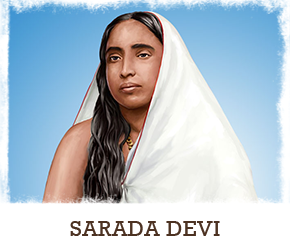
Sri Sarada Devi, the spiritual consort of Sri Ramakrishna II श्री शारदा देवी, श्री रामकृष्ण के आध्यात्मिक पत्नी


Endearingly known as ‘Holy Mother’, Sri Sarada Devi, the spiritual consort of Sri Ramakrishna, was born on 22 December 1853 in Jayrambati, a village in West Bengal.
As a child Sarada was devoted to God and spent most of her time helping her mother in various household chores like caring for younger children, looking after cattle and carrying food to her father and others engaged in work in the field. She had no formal schooling but managed to learn the Bengali alphabet. When she was about six years old, she was married to Sri Ramakrishna, according to the custom prevalent in India in those days. However, after the event, she continued to live with her parents, while Sri Ramakrishna lived a God-intoxicated life at Dakshineshwar.
At the age of eighteen, she walked all the way to Dakshineshwar to meet her husband. Sri Ramakrishna, who had immersed himself in the intense practice of several spiritual disciplines for more than twelve years, had reached the highest state of realization in which he saw God in all beings. He received Sarada Devi with great affection and allowed her to stay with him. He taught her how to lead a spiritual life while discharging her household duties. They led absolutely pure lives, and Sarada Devi served Sri Ramakrishna as his devoted wife and disciple while remaining a virgin nun and following the spiritual path.
Sri Ramakrishna looked upon Sarada Devi as a special manifestation of Divine Mother of the universe. In 1872, on the night of the Phala-Harini-Kali-puja, he ritualistically worshipped Sarada Devi as the Divine Mother, thereby awakening universal Motherhood latent in her. When disciples began to gather around Sri Ramakrishna, Sarada Devi learned to look upon them as her own children. The room in which she stayed at Dakshineshwar was too small to live in and had hardly any amenities, and on many days she did not get the opportunity of meeting Sri Ramakrishna. But she bore all difficulties silently and lived in contentment and peace, serving the increasing number of devotees who came to see Sri Ramakrishna.
After Sri Ramakrishna’s passing away in 1886, Sarada Devi spent some months in pilgrimage and then went to Kamarpukur where she lived in great privation. Coming to know of this, the disciples of Sri Ramakrishna brought her to Kolkata. This marked a turning point in her life. She now began to accept spiritual seekers as her disciples and became the open portal to immortality for hundreds of people. Her great universal mother-heart, endowed with boundless love and compassion, embraced all people without any distinction, including many who had lived sinful lives.
When the Western women disciples of Swami Vivekananda came to Kolkata, the Holy Mother accepted them with open arms as her daughters, ignoring the restrictions of the orthodox society of those days. Although she had grown up in a conservative rural society without any access to modern education, she held progressive views, and wholeheartedly supported Swami Vivekananda in his plans for rejuvenation of India and the uplift of the masses and women. She was closely associated with the school for girls started by Sister Nivedita.
Although she was highly venerated for her spiritual status, and literally worshipped as the Divine Mother, she continued to live like a simple village mother, washing clothes, sweeping the floor, bringing water from the pond, dressing vegetables, cooking and serving food. At Jayrambati she lived with her brothers and their families. They gave her endless troubles but, established as she was in the awareness of God and in Divine Motherhood, she always remained calm and self-possessed, showering love and blessings on all who came into contact with her. As Sister Nivedita stated, “Her life was one long stillness of prayer.”
In the history of humanity, there has never been another woman who looked upon herself as the Mother of all beings, including animals and birds and spent her whole life in serving them as her children, undergoing unending sacrifice and self-denial. About her role in the mission of Sri Ramakrishna on earth, she stated: “My son, you know the Master had a maternal attitude (Matri-bhava) towards everyone. He has left me behind to manifest that Divine Motherhood in the world.”
Under the strain of constant physical work and self-denial and repeated attacks of malaria, her health deteriorated in the closing years of her life, and she left the mortal world on 21 July 1920.
Ideal Woman
On account of her immaculate purity, extraordinary forbearance, selfless service, unconditional love, wisdom and spiritual illumination, Swami Vivekananda regarded Sri Sarada Devi as the ideal for women in the modern age. He believed that with the advent of Holy Mother, the spiritual awakening of women in modern times had begun.
Swami Vivekananda on Holy Mother Sri Sarada Devi: You have not yet understood the wonderful significance of Mother’s life — none of you. But gradually you will know. Without Shakti (Power) there is no regeneration for the world. Why is it that our country is the weakest and the most backward of all countries?– because Shakti is held in dishonor there. Mother has been born to revive that wonderful Shakti in India, and making her the nucleus, once more will Gargis and Maitreyis be born into the world.
(Complete Works of Swami Vivekananda, Volume 7, p. 484)

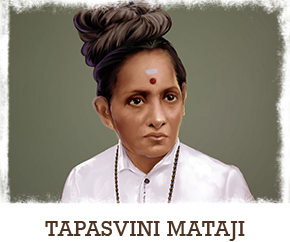
Tapasvini Mataji II راهبة، الأم


Mataji Gangabai or Tapasvini Mataji, as she was popularly called, was one of the pioneers in women’s education in India. Little is known about her life. She is believed to be born in 1835 in South India to a royal family belonging to Maharashtra. She is said to be a niece of Rani Lakshmibai of Jhansi though of the same age. From her childhood, she had prodigal memory and had deeply studied Sanskrit grammar, literature and scriptures. She was also trained in armed combat. After the demise of her father, she governed her estate well and started to build a strong state. However, soon after she gave up her estates and took to the ascetic life and came to be called as Tapasvini Mataji. During the freedom struggle of 1857, she plunged herself into the armed struggle herself leading a group of soldiers. After the movement subsided, Gangabai left for Nepal and resumed her spiritual practices. She is said to have influenced religious lives in Nepal and parts of Northern Bihar.
Having felt that education of women on Indian cultural and spiritual lines was the most important service needed for the nation, Mataji Gangabai came to Calcutta, then capital of British empire in India, and started imparting education to girls. She started her girls’ school called Mahakali Pathshala in Kolkata in April 1893 with only 30 students which gradually increased six-fold within 5 years. She had also started a press to publish books on moral and value-based teachings. She maintained her contact with many national leaders, like Bal Gangadhar Tilak and Sister Nivedita to inspire patriotism among the people. She was widely respected and admired. Tapasvini Mataji passed away on 20 April 1907 at Varanasi.
The fame of Mahakali Pathshala had spread far and wide. The students were taught about Indian ethos and cultural values free of cost. Having heard of the school, Swami Vivekananda came to visit it on 6 May 1897. Swamiji expressed his great appreciation of the measure of success Mataji had attained by her perseverance and application in the cause of diffusing education among women. In reply, she said with much humility, ‘In my service to my students, I look upon them as the Divine Mother; well, in starting the school I have neither fame nor any other object in view.’
After saluting Mataji, Swamiji went back to his carriage, which then proceeded towards Baghbazar, while the following conversation took place between Swamiji and the disciple.
Swamiji: How far is the birthplace of this venerable lady! She has renounced everything of her worldly life, and yet how diligent in the service of humanity! Had she not been a woman, could she ever have undertaken the teaching of women in the way she is doing? … The duty of teaching in the school ought to devolve in every respect on educated widows and Brahmacharinis. ….
Still, on this sacred soil of India, this land of Sita and Savitri, among women may be found such character, such spirit of service, such affection, compassion, contentment, and reverence, as I could not find anywhere else in the world!’
In the visitors’ book, Swami Vivekananda had made the following comment about the school: ‘I have great pleasure in witnessing to the good work inaugurated in our city by ‘Mataji’. The more appears to be in the right direction, and diseases support of all who desire to see their daughters educated on national lines!’
What Swamiji felt about the endeavours by the likes of Mataji has been summed up in his saying: ‘Studying the present needs of the age, it seems imperative to train some women up in the ideal of renunciation, so that they will take up the vow of lifelong virginity, fired with the strength of that virtue of chastity which is innate in their life-blood from hoary antiquity. Along with that, they should be taught sciences and other things which would be of benefit, not only to them but to others as well, and knowing this they would easily learn these things and feel pleasure in doing so. Our motherland requires for her well-being some of her children to become such pure-souled Brahmacharins and Brahmachari.’

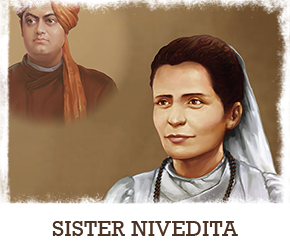
Nivedita was born Margaret Elizabeth Noble II निवेदिता पैदा हुआ था मार्गरेट एलिजाबेथ नोबल


 Nivedita was born Margaret Elizabeth Noble on 28th October 1867 in North Ireland. Inspired by the influence of her father and forefathers on the one hand and the ideals of her maternal grandfather on the other, she developed in her character truthfulness, religious zeal, patriotism and also an attraction for politics.

After successfully completing her formal education, Margaret became a teacher. She opened a school and started to teach students following her own methods due to which her name as a good teacher spread far and wide. She also started contributing articles in various papers and periodicals and participated in Church-sponsored service work.
Margaret met Swami Vivekananda in November 1895 at London. She was charmed by his philosophical exposition and the personality and began attending all the classes and lectures, raised questions to resolve her doubts and constantly meditated on them. At last, she accepted him as her Guru. Swamiji was also convinced of Margaret’s truthfulness, determination and above all, her heart full of kindness.
Swamiji used to feel unbearable pain at the sorrows and sufferings of the common people of a subjugated India. He felt that in order to raise India it was necessary to improve the condition of the common mass and that of women. The only way to improve the condition of women was to give them an education. With the spread of education, they would become self-confident and would be able to solve their own problems. Swamiji thought Margaret would be eminently suitable for this task. He invited her for the task of spreading education among the women of India.
Margaret left behind her motherland, friends and relations, an established life and everything, and reached India on 28th January 1898 to join Swamiji’s task of nation-building. But first of all, it was necessary to know India. So day after day, patiently and with delicate care, Swamiji explained to her India’s history, philosophy, literature, the life of the common mass, social traditions, and also the lives of great personalities, both ancient and modern. She began to love India and developed an irresistible urge to accept the Indian life. Gradually India and she were merged together, as it were, to become one.
After a short while, Swamiji formally initiated Margaret in the vow of Brahmacharya and gave her the name ‘Nivedita’. He advised her to maintain strict continence and to dedicate her life for the good of others, like Buddha. Henceforth, the sole purpose of her life was to serve India. So she deemed her service to India to be the service to the entire mankind indeed.
As desired by Swamiji, she set up a Girls’ school at Kolkata and started the work of women’s education following the national ideal of India. She believed that in future Maitreyis and Gàrgis would emerge from amongst the students of this school. Nivedita used to teach the students history, geography, natural sciences and a little bit of English. She would also teach them sewing, drawing, and handicrafts. She also encouraged them to take up physical exercises. Above all, she helped them increase their innate sense of religion and introduced them to the Indian culture. She also made arrangements so that elderly married ladies and widows might have a little learning and know the art of sewing and other handicrafts. She gave special instructions to a few educated ladies in order to make them good teachers.
In 1902 after Swamiji’s passing away, Nivedita took upon herself the unfinished tasks of Swamiji. Since her arrival in India, Nivedita had realized in the core of her heart that foreign rule was responsible for the moral degradation and weakness of the Indians. From then on, Nivedita tried her utmost to enthuse entire India with the nationalist ideas. Nivedita’s conception of nationalism was to awaken a nationalistic consciousness in all the areas of national life—education, literature, science, history, arts and folk culture. Carrying afloat the banner of Swamiji’s ideals, Nivedita now set out on lecture tours throughout India. She appealed to the countrymen to forget all differences of caste, creed, and culture and come forward united to serve the motherland. Herself the image of selflessness, renunciation, and austerity, Nivedita’s sincere appeal touched the hearts of the people and enkindled patriotism in many a heart. She especially associated herself with the youths and student community.
During the Swadeshi Movement in 1905, Nivedita helped the leaders and the workers of the movement through all possible means. Nivedita maintained very close relations with Sri Aurobindo, the chief of the then revolutionary movement and other revolutionary leaders and workers. She was in touch with most of the front-ranking political leaders throughout India. Her foremost effort was that the Indians should unitedly fight against the foreign rule without creating divisions amongst themselves.
Nivedita accepted India as her own country serving the people of India in their days of sufferings and distress, caring even the least for her own life. In 1899, when the plague broke out in Calcutta she plunged into relief work with the band of sannyàsins of the Ramakrishna Mission according to Swamiji’s desire. Under her leadership, nursing of the ailing patients began, and side by side as a remedial measure to fight the disease, the cleaning operation of rubbish and refuse of the localities continued. Following her example, many local youths joined the relief work. When East Bengal was ravaged by a terrible flood, followed by a famine, she rushed there with her people for relief work. Wading through water and mud she reached the doorsteps of the common people and began to serve the distressed mass of people. Those distressed people also regarded Nivedita as their own and accepted her service without any reservation.
Nivedita encouraged and patronized the eminent Indian scientist Jagadish Chandra Bose, artists Abanindranath Tagore and Nandalal Bose, thinkers and historians Romesh Chandra Dutt and Jadunath Sarkar and other eminent personalities. She was an extraordinary orator and a powerful writer and wrote many books and articles.
Due to tremendous hardships and unfavorable climate, she began to fall ill repeatedly and finally passed away on 13 October 1911.
She always identified herself as ‘Nivedita of Ramakrishna-Vivekananda’. Never did anyone love India so much as did Nivedita. Never have we came across anyone who felt so proud about India’s religion and culture as she did or so committed to India’s national awakening as she was. By totally dedicating herself to the service of India, Nivedita proved true the name that was gifted to her by her Guru.

women in ancient times taking the same share as men, and in no other literature of the world.

Swami Vivekananda
@page { margin: 2cm } p { margin-bottom: 0.25cm; direction: ltr; font-variant: normal; color: #181818; letter-spacing: normal; line-height: 120%; text-align: left; orphans: 2; widows: 2; text-decoration: none } p.western { font-family: “Merriweather”, “Georgia”, serif; font-size: 15pt; font-style: normal; font-weight: normal } p.cjk { font-size: 15pt } p.ctl { font-family: “inherit”; font-size: 15pt; font-style: normal; font-weight: normal } a:link { so-language: zxx }

Swami Vivekananda


The accompanying address was conveyed at  Cambridge, December 17, 1894, 
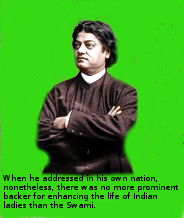
what’s more, recorded by Miss Frances Willard’s stenographer. Swami Vivekananda confronted extremism in America on a few issues of Indian culture- – one was the Indian lady. Normally, he looked to revise Western misguided judgments. When he addressed in his own nation, nonetheless, there was no more prominent backer for enhancing the life of Indian ladies than the Swami. 


In talking about the ladies of India, women, and respectable men, I feel that I am will discuss my moms and sisters in India to the ladies of another race, a large number of whom have been similar to moms and sisters to me. In any case, however, tragically, inside exceptionally ongoing occasions there have been mouths just to revile the ladies of our nation, I have discovered that there are some who favor them as well. I have discovered such respectable spirits in this country as Mrs. [Ole] Bull and Miss [Sarah] Farmer and Miss [Frances] Willard, and that brilliant delegate of the most noteworthy privileged of the world, whose life helps me to remember that man of India, six hundred years previously the introduction of Christ, who surrendered his royal position to blend with the general population. Woman Henry Somerset has been a disclosure to me. I end up strong when I find such honorable spirits who won’t revile, whose mouths are brimming with gift for me, my nation, our people, and whose hands and hearts are ever prepared to do administration to humankind. 


I initially mean to bring a look into times past of Indian history, and we will discover something extraordinary. Every one of you know, maybe, that you Americans and we Hindus and this woman from Iceland [Mrs. Sigrid Magnusson] are the relatives of one basic heritage known as Aryans. Most importantly, we discover three thoughts wherever the Aryans go: the town network, the privileges of ladies and an upbeat religion Since Swami Vivekananda’s time there has been more research on the spread of the Aryan culture. 


The main [idea] is the arrangement of town networks – as we have quite recently gotten notification from Mrs. Bull concerning the North. Each man was his very own [lord?] and claimed the land. All these political organizations of the world we currently observe, are the advancements of those town frameworks. As the Aryans headed toward various nations and settled, certain conditions built up this establishment, others that. 


The following thought of the Aryans is the opportunity of ladies. It is in the Aryan writing that we discover ladies in old occasions accepting indistinguishable offer from men, and in no other writing of the world. 


Returning to our Vedas- – they are the most established writing the world has and are made by your and my basic precursors (they were not composed in India- – maybe on the shore of the Baltic, maybe in Central Asia- – we don’t have the foggiest idea).

Their most seasoned part is made out of songs, and these psalms are to the divine beings whom the Aryans loved. I might be exculpated for utilizing the word divine beings; the exacting interpretation is “the splendid ones”. These psalms are devoted to Fire, to the Sun, to Varuna and different divinities. The titles run: “such and such a sage formed this section, devoted to such and such a divinity”. 

In the tenth part goes to an impossible to miss psalm – for the sage is a lady – and it is committed to the one God who is at the foundation of every one of these divine beings. All the past songs are talked in the third individual as though somebody were tending to the gods. Be that as it may, this psalm takes a takeoff: God [as the Devi] is representing herself. The pronoun utilized is “I”. “I am the Empress of the Universe, the Fulfiller all things considered.” Vide “Devi Sukta”, Rig Veda 10.125. 

This is the primary look at ladies’ work in the Vedas. As we go on, we discover them taking a more noteworthy offer – notwithstanding administering as clerics. There isn’t one section all through the entire mass of writing of the Vedas which can be understood even in a roundabout way as implying that lady would never be a minister. Actually, there are numerous precedents of ladies administering as ministers. 

At that point we go to the last part of these Vedas- – or, in other words religion of India- – the concentrated intelligence of which has not been outperformed even in this century. There, as well, we discover ladies transcendent. A huge part of these books are words which have continued from the mouths of ladies. It is there- – recorded with their names and lessons. 

There is that delightful story of the extraordinary sage Yâjnavalkya, the person who visited the kingdom of the incredible lord Janaka. What’s more, in that that get together of the educated, individuals came to make inquiries. One man asked him, “How am I to play out this forfeit?” Another asked him, “How am I to play out the other forfeit?” And after he had addressed them, there emerged a lady who stated, “These are silly inquiries. Presently, have a consideration: I take these two bolts, my two inquiries. Answer them on the off chance that you can, and we will then consider you a sage. The first is: What is the spirit? The second is: What is God?” Brihadâranyaka Upanishad 3.8.1 12. 

In this manner emerged in India the incredible inquiries concerning the spirit and God, and these originated from the mouth of a lady. The sage needed to pass an examination before her, and he passed well. 

Going to the following stratum of writing, our sagas, we find that instruction has not deteriorated. Particularly in the position of sovereigns, this perfect was most magnificently held. 

In the Vedas we discover this thought of wedding – the young ladies decided for themselves; so the young men. In the following stratum, they are hitched by their folks, with the exception of in one position.
That magnificent vessel which has been conveying for a very long time people over this sea of life may have sprung little holes all over. What’s more, of that, as well, the Lord alone knows what amount is attributable to themselves and the amount to the individuals who look down with disdain upon the Hindus. 

Be that as it may, if such holes there are, I, the meanest of her kids, think it my obligation to prevent her from sinking regardless of whether I need to do it with my life. What’s more, in the event that I locate that every one of my battles are futile, still, as the Lord is my observer, I will let them know with my sincere blessing: “My brethren, you have done well- – nay, superior to anything some other race could have done under similar conditions. You have given me all that I have. Allow me the benefit of being next to you to the last and let every one of us sink together”. 

Indeed, even here I would request that you take a gander at another side. Whatever might be said of the Hindus, they are a standout amongst the most learned races the world has ever delivered. The Hindu is the metaphysician; he applies everything to his brains. Everything must be settled by celestial computation. 

The thought was that the stars administer the destiny of each man and lady. Indeed, even today when a youngster is conceived, a horoscope is thrown. That decides the character of the youngster. One youngster is conceived of a perfect sort, another of a human, others of lower character. 

The trouble was: If a kid who was of a beast character was joined with an offspring of a decent character, would they not tend to deteriorate one another? 

The following trouble was: Our laws did not permit marriage inside similar factions. Not exclusively may one not wed inside his own family- – or even one of his cousins- – however one must not wed into the tribe of his dad or even of his mom. 

A third trouble was: If there had been uncleanliness or phthisis or any such serious ailment inside six ages of either lady of the hour or spouse, at that point there must not be a marriage. 

Presently taking [into account] these three troubles, the Brahmin says: “On the off chance that I abandon it to the decision of the kid or young lady to wed, the kid or young lady will be intrigued with an excellent face. And after that conceivable every one of these conditions will convey destroy to the family”. This is the essential thought that oversees our marriage laws, as you will discover. Regardless of whether right or wrong, there is this logic out of sight. Anticipation is superior to fix. 

That hopelessness exists in this world is on the grounds that we bring forth wretchedness. So the entire inquiry is the manner by which to keep the introduction of hopeless kids. How far the privileges of a general public ought to reach out over the individual is an open inquiry. In any case, the Hindus say that the decision of marriage ought not be left in the hands of the kid or young lady.
I don’t intend to state this is the best activity. Nor do I see that abandoning it in their grasp is at all an ideal arrangement. I have not discovered an answer yet as far as I could tell; nor do I see that any nation has one. 

We come alongside another image. I disclosed to you that there was another specific type of marriage (for the most part among the sovereignty) where the dad of the young lady welcomed distinctive rulers and aristocrats and they had a gathering. The young woman, the girl of the ruler, was borne on a kind of seat before every last one of the rulers thus. Also, the messenger would rehash: “This is Prince So thus and these are his capabilities”. The young lady would either pause or say, “Proceed onward”. What’s more, before the following ruler, the messenger would likewise give a depiction, and the young lady would state, “Proceed onward”. (This would be organized in advance; she previously had the enjoying for someone before this.) Then, finally, she would solicit one from the workers to toss the laurel over the leader of the man, and it is tossed to demonstrate he was acknowledged. (The remainder of these relational unions was the reason for the Mohammedan attack of India.) Vide pp. 198 99 for the tale of Samyuktâ, the little girl of a Rajput ruler, who turned into the Queen of Delhi.  These relational unions were exceptionally saved for the sovereign standing. 

The most established Sanskrit lyric in presence, the Râmâyana, has epitomized the loftiest Hindu perfect of a lady in the character of Sitâ. We have not an opportunity to experience her life of interminable persistence and goodness. We revere her as God in essence, and she is named before her significant other, Râma. We say not “Mr. what’s more, Mrs.”, however “Mrs. what’s more, Mr.” et cetera, with every one of the divine beings and goddesses, naming the lady first. 

There is another impossible to miss origination of the Hindu. The individuals who have been considering with me know that the focal origination of Hindu logic is of the Absolute; that is the foundation of the universe. This Absolute Being, of whom we can predicate nothing, has Its forces talked about as She- – that is, the genuine individual God in India is She. This Shakti of the Brahman is dependably in the female sexual orientation. Rama is viewed as the sort of the Absolute, and Sita that of Power. We have no opportunity to go over all the life of Sita, however I will cite an entry from her life that is especially suited to the women of this nation. 

The image opens when she was in the timberland with her significant other, regardless of whether they were expelled. There was a female sage whom they both went to see. Her fasts and commitments had withered her body. 

Sita moved toward this savvy and bowed down before her. The sage put her hand on the head of Sita and stated: “It is an extraordinary gift to have an excellent body; you have that. It is a more prominent gift to have a respectable spouse; you have that. It is the best gift to be splendidly dutiful to such a spouse; you are that. You should be cheerful”. 

Sita answered, “Mother, I am happy that God has given me a wonderful body and that I have so committed a spouse. Be that as it may, with regards to the third gift, I don’t know whether I obey him or he obeys me. One thing alone I recall, that when he took me by the hand before the conciliatory fire- – regardless of whether it was an impression of the fire or whether God himself influenced it to appear to me- – I found that I was his and he was mine. What’s more, from that point forward, I have discovered that I am an incredible supplement, and he of mine”. 

Parts of this ballad have been converted into the English dialect. Sita is the possibility of a lady in India and loved as God in essence. 

We come now to Manu the extraordinary lawgiver. Presently, in this book, there is a detailed depiction of how a kid ought to be taught. We should recollect that it was necessary with the Aryans that a kid is taught, whatever his station. Subsequent to portraying how a tyke ought to be taught, Manu includes: “Similarly, the girls are to be instructed – precisely as the young men”. Note: The content of this sentence isn’t found in the surviving Manu Samhitâ. Vide Mahânirvâna Tantra 8.47. 

I have frequently heard that there are different entries where ladies are denounced. I concede that in our holy books there are numerous entries which censure ladies as offering enticement; you can see that for yourselves. In any case, there are additionally sections that extol ladies as the intensity of God. What’s more, there are different entries which express that in that house where one drop of a lady’s tear falls, the divine beings are never satisfied and the house goes to destroy. Drinking wine, murdering a lady and executing a Brahmin are the most astounding wrongdoings in the Hindu religion. I concede there are harsh sentences [in a portion of our books]; however here I guarantee the predominance of these Hindu books, for in the books of different races there is just judgment and no great word for a lady. 

Next, I will go to our old shows. Whatever the books say, the dramatizations are the ideal portrayal of society as it at that point existed. In these, which were composed from four hundred years previously Christ forward, we find even colleges loaded with both young men and young ladies. We would not [now] discover Hindu ladies, as they have since turned out to be cut off from advanced education. Since Swami Vivekananda’s time, advanced education among ladies in India has spread quickly. 

Be that as it may, [at that time], they were wherever practically the equivalent as they are in this nation – going out to the patio nurseries and parks to take promenades. 

There is another point which I bring before you and where the Hindu lady is as yet better than every single other lady on the planet – her rights. The privilege to have property is as total for ladies in India with respect to men- – and has been for a great many years. 

On the off chance that you have any legal advisor companion and can take up editorials on the Hindu law, you will think that its for yourselves. A young lady may convey a million dollars to her significant other, yet every dollar of that is hers. No one has any privilege to contact one dollar of that. On the off chance that the spouse bites the dust without issue, the entire property of the husband goes to her, regardless of whether his dad or mom is living. What’s more, that has been the law from the past to the present time. That is something which the Hindu lady has had past that of the ladies of different nations. 

The more seasoned books- – or even more current books- – don’t disallow the Hindu dowagers from being hitched; it is a mix-up to think so. They give them their decision, and that is given to the two people. The thought in our religion is that marriage is for the frail, and I don’t perceive any motivation to surrender that thought today. They who end up total – what is the utilization of their wedding? What’s more, those that wed – they are given one possibility. At the point when that shot is finished, the two people are looked downward on in the event that they wed once more; yet it isn’t that they are disallowed. It is no place said that a dowager isn’t to wed. The dowager and widower who don’t wed are viewed as more otherworldly. 

Men, obviously, get through this law and go and wed; while ladies – they being of a higher profound nature- – keep to the law. For example, our books say that eating meat is awful and wicked, however you may in any case eat such and such a meat- – sheep, for example. I have seen a great many men who eat sheep, and never in my life have I seen a lady of higher rank who eats the meat of any sort. This demonstrates their inclination is to keep the law- – keeping more towards religion. Yet, don’t judge too brutally of Hindu men. You should endeavor to take a gander at the Hindu law from my position as well, for I am a Hindu man. 

This non-marriage of dowagers step by step developed into a custom. Also, at whatever point in India a custom winds up unbending, it is relatively difficult to get through it- – similarly as in your nation, you will discover that it is so difficult to get through a multi day custom of form. In the lower stations, aside from two, the dowagers remarry. 

There is an entry in our later law books [which states] that a lady will not peruse the Vedas. Be that as it may, they are prohibited  even a feeble Brahmin. In the event that a Brahmin kid isn’t solid disapproved, the law is connected to him too. In any case, that does not demonstrate that training is disallowed to them, for the Vedas are not all that the Hindus have. Each and every other book ladies can peruse. All the mass of Sanskrit writing, that entire sea of writing – science, dramatization, verse – is just for them. They can go there and read everything, aside from the [Vedic] sacred texts. Today Indian ladies are never again banned from perusing any sacred writing – Vedic or non-Vedic. 

In later days the thought was that lady was not proposed to be a cleric; so what is the utilization of her concentrate the Vedas? In that, the Hindus are not so a long ways behind different countries. At the point when ladies surrender the world and join our Order, they are never again considered either men or ladies. They have no sex. The entire inquiry of high or low position, man or lady, vanishes completely. 

Whatever I am aware of religion I gained from my lord, and he learned it of a lady. 

Returning to the Rajput lady, I will attempt to convey to you a story from a portion of our old books- – how amid the Mohammedan victory, one of these ladies was the reason for what prompted the success of India. 

A Rajput ruler of Kanauj- – an extremely antiquated city- – had a girl [Samyukta]. She had known about the military acclaim of Prithvi Rai [King of Ajmer and Delhi] and all his grandness, and she was infatuated with him. Presently her dad needed to hold a Râjasuya forfeit, so he welcomed every one of the lords in the nation. What’s more, in that forfeit, they all needed to render modest administration to him since he was unrivaled in general; and with that forfeit, he pronounced there would be a decision by his little girl. 

However, the little girl was at that point in affection with Prithvi Rai. He was forceful and was not going to recognize steadfastness to the ruler, her dad, so he declined the welcome. At that point the lord made a brilliant statue of Prithvi Rai and put it close to the entryway. He said that that was the obligation he had offered him to perform- – that of a watchman. 

The upshot of the entire issue was that Prithvi Rai, similar to a genuine knight, came and took the woman behind him on his steed, and they both fled. 

At the point when the news went to her dad, he gave pursue with his armed force, and there was an incredible fight in

Swami Vivekananda
@page { margin: 2cm } p { margin-bottom: 0.25cm; direction: ltr; font-variant: normal; color: #181818; letter-spacing: normal; line-height: 120%; text-align: left; orphans: 2; widows: 2; text-decoration: none } p.western { font-family: “Merriweather”, “Georgia”, serif; font-size: 15pt; font-style: normal; font-weight: normal } p.cjk { font-size: 15pt } p.ctl { font-family: “inherit”; font-size: 15pt; font-style: normal; font-weight: normal } a:link { so-language: zxx }

Swami Vivekananda
 That superb vessel which has been conveying for a long time people over this sea of life may have sprung little breaks all over. Also, of that, as well, the Lord alone knows what amount is attributable to themselves and the amount to the individuals who look down with hatred upon the Hindus. 

Yet, in the event that such breaks there are, I, the meanest of her kids, think it my obligation to prevent her from sinking regardless of whether I need to do it with my life. Furthermore, in the event that I locate that every one of my battles are futile, still, as the Lord is my observer, I will let them know with my ardent invocation: “My brethren, you have done well- – nay, superior to anything some other race could have done under similar conditions. You have given me all that I have. Allow me the benefit of being next to you to the last and let all of us sink together”.

Ahalyabai(1735年から1795年)はMnkoji Shinde小の一つ

Ahalyabai(1735年から1795年)はMnkoji Shinde小の一つ、これらの娘の生息地だったオーランガバードの地区でした。彼女はその後、Kndujiの生息地と結婚し、生息地胡主席は曽根のMlhrro、信頼できるアシスタントのペーシュワーました。 Knduji、Unfaortunateliは、プレジャー・シークと無痛人を生息地。 Ahalyabai、Hovever、墓副ベイインテリジェント女従順。彼女の父の義理の管理と操作のKced Responsibilitisと国政は、すぐに操作Intrsted。 Xiのエクステント二人の子供:息子と娘。1754でKnduji DIAD、今日Ahalyabai Anergisはすべて除外された操作した国政を流用しました。死後Mlhrro、Mlerao、彼女の息子は除外した、Nominlly Subhdarの生息地としました。しかし、彼女はFakto定規滞留しませんでした。個人的に軍を操作リードする、彼女はKrused反乱反乱除外除外されたラージプートの一族と私もビール族の部族のKvelled、Satpuraを望んでいました。彼女の息子は胡Awantualli DIAD後非常識になる、週志向の少年に住んでいます。娘の夫のもKmitedは隣接火葬を操作します。これらのヴィアグレートBlusだからAhalyabai、と彼女は彼女DIAD 1795年8月XIIIティルOsteritiの生活を送っています。サー・ジョン・Mlkm Deskribsは私達「エヴァーAksistedをあやしピュアレストとほとんどAksmplary Rulrsのいずれかを操作します。」 REMEN問い合わせフォームは除外しました多くの良いものは、各PAT記念碑Ahalyabaiをあやしたそれらの高速道路、ウェールズ、GTS、残り-家、および寺院でした。最初のうちねえベナレスとコルカタからのロードはヴィシュヌ、グジャラート州ソームナートの寺院だった最もNotwartiだったそうだった、とタブレットBisweshwara(VP)バラナシ。彼女はまだインド思い出しThrugout Benevolensとちょうど規則のために操作です。ヴィヴェーカーナンダのAhalyabai:彼らはショールを持参その後、インドグレートフィアレス女性の必要があった – FIT女性英雄のベイMoters、ちょっと彼らがノーBikoz – 女性はレイラ、アハリヤー白、およびMirabai、その後Sngmittaを続行のVrti Trdisnsましたそして、Selflesは、感動的だった除外神の足ケースの強さに好調に推移しました。」(OFヴィヴェーカーナンダ、ボリューム5の全集に、p。231)「これまでAhalyabai最も偉大女性Prhapsビーンクイーン程度でした。」


(マスターは偽鋸雪、シスター・ニヴェーディター、Pk24ました

Ahalyabai II Ahalyabai, however, grew up to be an intelligent and dutiful woman

Ahalyabai
Ahalyabai
Ahalyabai (1735-95) was the daughter of one Manakoji Shinde of Chanute, in the district of Aurangabad. She was married to Khanduji, who was the son of Malhararao, a trusted assistant of the Peshwa. Khanduji, unfortunately, was a pleasure-seeking an indolent person. Ahalyabai, however, grew up to be an intelligent and dutiful woman. Her father-in-law coached her in administration and soon entrusted her with responsibilities of state affairs. She had two children: a son and a marriageable girl.
Khanduji died in 1754, and Ahalyabai then diverted all her energies to the affairs of the State. After the death of Malhararao, Malerao, her son, was nominally made the subahdar. But she was the de facto ruler.
Personally leading her army, she crushed the revolt of a Rajput clan and also quelled the revolt of the Bhil tribes of, Satpura.
Her son was a weak-minded boy, who eventually died after becoming insane. Her daughter also committed sat on her husband’s pyre. These were great blows to Ahalyabai, and she lived a life of austerity till she died on 13 August 1795.
Sir John Malcolm describes her as ‘one of the purest and most exemplary rulers that ever existed.’ The many good things that Ahalyabai did remain as monuments to her piety in the form of highways, wells, ghats, rest-houses, and temples. The most noteworthy among them is the road from Kolkata to Benaras and the temples of Somnath in Gujarat, of Vishnu at Gaya, and of Vishweshwara (Vishwanath) at Varanasi. She is still remembered throughout India for her benevolence and just rule.
Swami Vivekananda on Ahalyabai: So shall we bring to the need of India great fearless women — women worthy to continue the traditions of Sanghamitta, Lila, Ahalya Bai, and Mira Bai — women fit to be mothers of heroes, because they are pure and selfless, strong with the strength that comes of touching the feet of God.”
(Complete Works of Swami Vivekananda, Volume 5, page. 231)
Ahalyabai Rani had been perhaps the greatest woman who ever lived.’

(The Master As I Saw Him, Sister Nivedita, page.24

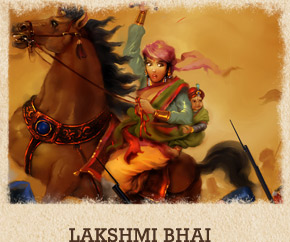
Rani Lakshmi Bai II One of most valiant women in Indian history was Rani Lakshmi Bai.

One of most valiant women in Indian history was Rani Lakshmi Bai. She was born on 18 November 1835 at Varanasi and was married early to Subahdar Gangadhar Rao, head of the small Maratha State of Jhansi formed by the Peshwas in 1743. The Subahdar died without issue in 1853, and his widow Lakshmi Bai was not permitted by the Governor-General-in-Council to adopt a successor. Jhansi was annexed to the British administration. The Rani, who was given a small pension, could not reconcile herself to ignominy and de¬pendence.

The rebellion began in India with the rise of the sepoys against their British officers at Meerut and Delhi on 10 May 1857, and gradually it spread to other parts of northern India.
On 5 June 1857 rebellion broke out at Jhansi, and the Rani stoutly defended the fort of Jhansi against Sir Hugh Rose. ‘It was the Rani of Jhansi’s evistom, states her own personal servant to Major S. C. McPherson, the political agent at Gwalior, “to lead her troops dressed in military uniform of the irregular cavalry—a crimson jacket, crimson trousers and a white turban, which made it impossible to tell her sex.'” Ultimately, finding her position exceedingly precarious, she made her adventurous escape from the fort through the cordon of British troops and bravely fought against the British in Bundelkhand from Kunch to Kalpi. At Kunch the Rani joined the indomitable Tantia Topi.
General Rose thus reviewed the change in the military situation in Central India: ‘The high descent of the Rani, her unbounded liberality to her troops and retainers and her fortitude, which no reverses could shake, rendered her an influential and dangerous adversary.’ When the British force attacked, the Rani was personally directing the batteries. Overpowered both by numbers and superior arms, her army was defeated. The Rani, though she fought valiantly, was also killed.
Swami Vivekananda on Lakshmi Bai: This mild Hindu race produces fighting women from time to time. Some of you may have heard of the woman [Lakshmi Bâi, Queen of Jhansi] who, during the Mutiny of 1857, fought against the English soldiers and held her own ground for two years–leading modern armies, managing batteries and always charging at the head of her army. This queen was a Brahmin girl.
A man whom I know lost three of his sons in that war. When he talks of them he is calm, but when he talks of this woman his voice becomes animated. He used to say that she was a goddess–she was not a human being. This old veteran thinks he never saw better generalship.

(Complete Works of Swami Vivekananda, Volume 9, p. 200)

With such an education women will solve their own problems. They have all the time been trained in helplessness, servile dependence on others, and so they are good only to weep their eyes out at the slightest approach of a mishap or danger. Along with other things they should acquire the spirit of valour and heroism. In the present day, it has become necessary for them also to learn self – defence. See how grand was the Queen of Jhansi!

(Complete Works of Swami Vivekananda, Volume 5, p. 342)

Chand Bibi (1547-99 A.D.) decidedly holds the foremost place among the Indian Muslim women of the latter half of the sixteenth century.

Chand Bibi (1547-99 A.D.) decidedly holds the foremost place among the Indian Muslim women
of the latter half of the sixteenth century. Daughter of Husain Nizam Shah of Ahmadnagar, she was born there in 1547 and was married to Ali Adil Shah of Bijapur. She proved a great blessing to her husband, who, recognizing her rich talents, consulted her on all administrative matters. 
She used to ride with him on horseback to review the army parades and take an active part in his military campaigns, and when in 1580 her husband was treacherously murdered by a eunuch, and his nephew Ibrahim Adil Shah, a minor, succeeded him to the throne of Bijapur, she became the regent and the real ruler of his kingdom. However, the nobles, in order to grab power, conspired against her and even managed to confine her forcibly in a fortress in Satara. After being deposed in this manner, Chant Bibi was finally restored to her original position after a long struggle. But, when the Mughals attacked her kingdom, she was accused of treachery by a eunuch and was seized an executed in 1599. Lavish tributes have been paid to Chand Bibi by successive generations of India’s historians, which she deserves fully. In addition to her military genius and administrative skill, she was a good scholar of Arabic and Persian and could speak several Deccani languages fluently. Swami Vivekananda on Chand Bibi: The story of Chand Bibi, or Chand Sultana, is well known in India. She was the Queen of Golconda, where the diamond mines were. For months she defended herself. At last, a breach was made in the walls. When the imperial army tried to rush in there, she was in full armor, and she forced the troops to go back.—-(Complete Works of Swami Vivekananda, Volume 9, p. 201)

@page { margin: 2cm } p { margin-bottom: 0.25cm; direction: ltr; font-variant: normal; color: #181818; letter-spacing: normal; line-height: 120%; text-align: left; orphans: 2; widows: 2; text-decoration: none } p.western { font-family: “Merriweather”, “Georgia”, serif; font-size: 15pt; font-style: normal; font-weight: normal } p.cjk { font-size: 15pt } p.ctl { font-family: “inherit”; font-size: 15pt; font-style: normal; font-weight: normal } a:link { so-language: zxx }

Design a site like this with WordPress.com
Get started